

Risk-Based Vulnerability Management
Patch what can hurt you first.
Quine continuously combines vulnerability, exposure, software, network, and business context so your patch priority reflects the risk in your environment right now, not just a global severity score.
The score is global. Your risk is local.
A critical CVE isn't automatically your most urgent vulnerability.
Does it affect us?
Software + CVE
Can it be reached?
Exposure
What can it reach?
Blast radius
What should we patch first?
The hard part isn't finding vulnerabilities. It's keeping the patch order aligned to your actual risk as the environment changes.
Find that. Do this.
Find that
Continuously recognize when a vulnerability becomes an urgent risk in your environment.
- A CVE affects software you run.
- The asset is exposed.
- The vulnerability is known to be exploited.
- The asset can reach a critical business system.
Quine keeps those facts connected and the answer current.
Do this
Turn that risk into an immediate patch decision.
- Re-rank the patch queue automatically, immediately.
- Open the right ticket with details and priority.
- Show the affected assets and blast radius.
- Explain exactly why this vulnerability moved ahead of the others.
Instant explanations inside your existing workflow.
The priority and the evidence arrive together.
Your network changes the priority.
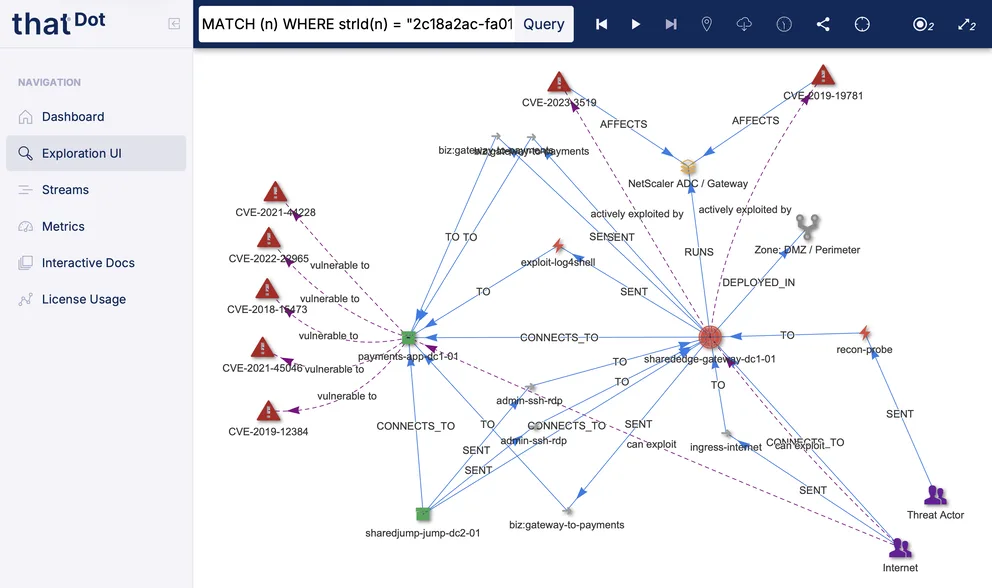
In the demo, a CVSS 10.0 vulnerability exists on 231 internal hosts. A lower-scored 9.8 vulnerability exists on one internet-facing gateway.
The gateway goes first.
Because the internal hosts are segmented from the internet, while the gateway provides a path through payments and check processing to the core ledger.
The two things are not the same
The severity score describes the vulnerability.
The connected environment determines the risk.
Reliable reasoning on live vulnerability data.
The answer to “What should we patch first?” changes whenever a CVE, asset, software package, network path, exposure, or business dependency changes. Quine keeps that context current and continuously re-evaluates the priority.
Current.
New vulnerabilities and infrastructure changes affect the patch order as they arrive.
Relevant.
Vulnerabilities that don't affect software you run don't create work.
Reliable.
Every priority can be traced back to the vulnerability, affected asset, exposure, exploit status, business criticality, and reachable systems behind it.
Add your network to the vulnerability score.
What is broken
Scanners
Vulnerability scanners are good at identifying flaws.
What is being used
Exploit intelligence
Exploit intelligence tells you which vulnerabilities attackers are using.
What can be reached
Exposure and attack paths
Attack-path and exposure tools help you understand reachability.
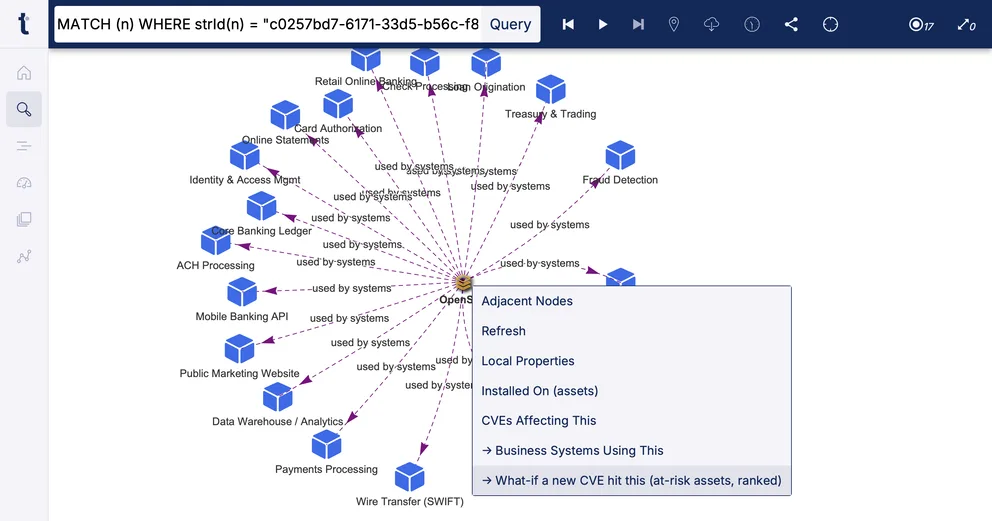
Quine keeps those inputs connected continuously, so the question isn't simply how severe a CVE is in general.
“How severe is this CVE?”
“How much risk does this CVE create here, now?”
That answer can change the moment the environment does.
Don't take our word for it. Run the prioritization.
The 304 non-matching CVEs create no triage work at all. The remaining vulnerabilities are prioritized using exposure, known exploitation, business criticality, and reachability into critical systems.
In the demo, the internet-facing gateway outranks 231 hosts carrying a higher-scored vulnerability, and the injected attack later follows the same path the prioritization had already identified.
Quine finds the important patch automatically.
Take action immediately with the full context.
This data is synthetic. The prioritization is reproducible, in your environment, at scale.
Let’s automate the patch decision you still reconstruct by hand.
If prioritization requires joining scanner results, SBOMs, exposure, topology, and business context after the fact, bring the data behind the decision. Quine keeps the answer current as both the vulnerabilities and your environment change.